Leave your details and we'll call you back
We can call you at a time that suits you.

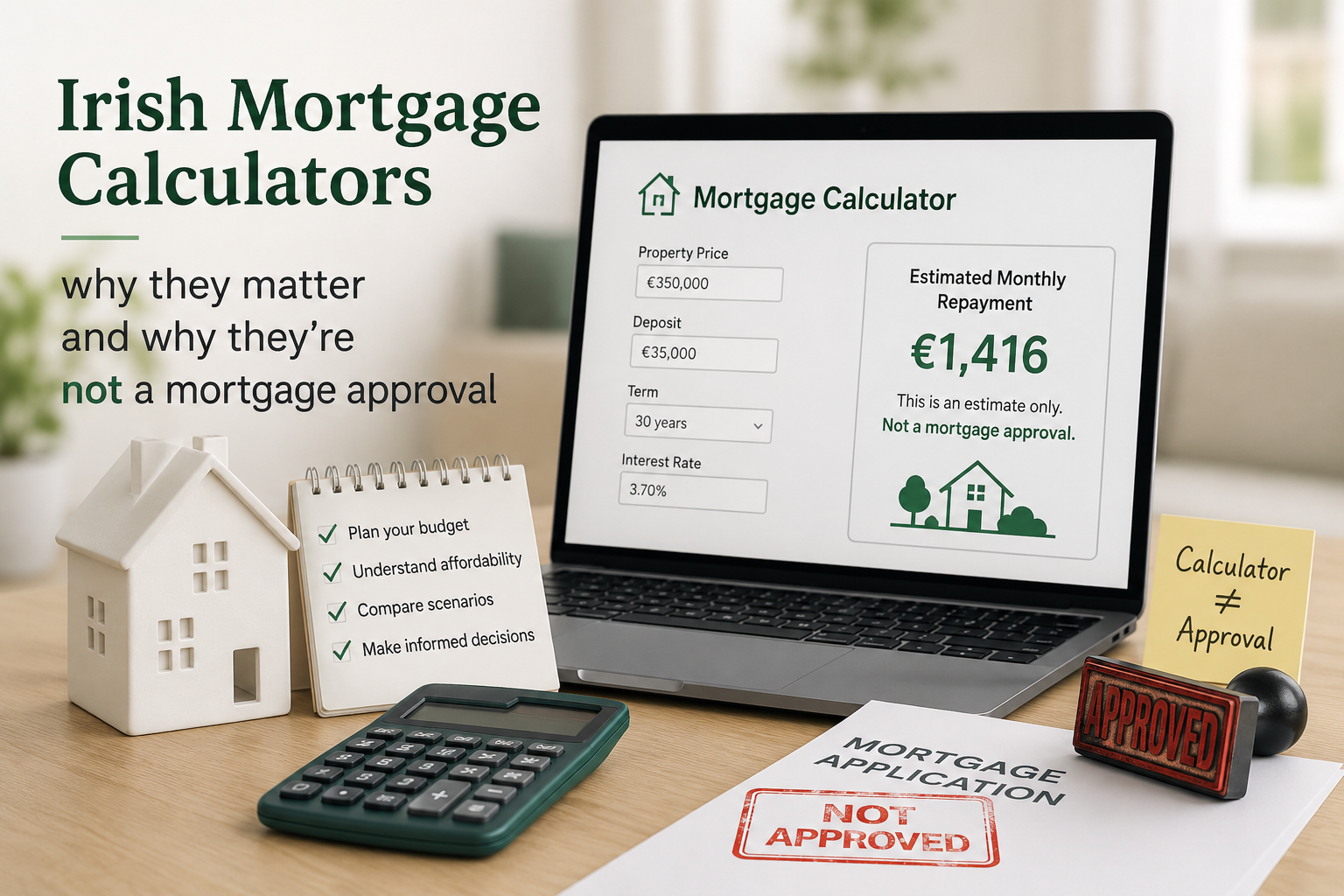
There are few things in Irish finance that people both love and misunderstand as much as the humble mortgage calculator. Type in a few numbers, move a slider around, change the term from 25 years to 30, and suddenly the future looks either manageable or horrifying. That’s not a bad thing.
A decent mortgage calculator…
A decent irish mortgage calculator is one of the handiest tools a buyer, mover, or switcher can use. Testing a mortgage overpayment calculator , or seeing where you stand with a first time buyer mortgage, the calculator gives you something useful: a starting point grounded in numbers rather than wishful thinking.
And make no mistake, wishful thinking is everywhere in property. A calculator is useful because it helps a person to stop speaking in vague terms like “sure it’ll probably be grand” and instead ask the better question: “What would this actually cost me every month?” We go from theory to reality fairly quickly doing that. That alone is a huge improvement.
If you are buying your first home, a mortgage payment calculator helps you turn a purchase price into a monthly reality. If you are looking at moving lender, a mortgage switch calculator or remortgage calculator can show you whether the effort is worth it. If you already have a mortgage and want to get rid of debt faster, a mortgage overpayment calculator can be a great motivator because it shows how even small extra payments can reduce interest over time. And if you are just looking for a broader budgeting tool, even a loan repayment calculator has value because the logic is similar: borrowing has a monthly cost, and that cost needs to fit your life.
Count the costs
That’s the good news. The bad news is that people often treat calculators as if they are miniature underwriters living inside a webpage. They are not. A calculator can tell you what a loan might cost. It cannot tell you whether a lender will actually give you that loan. That distinction matters more than most people realise.
What a mortgage calculator can’t do…
A mortgage calculator can estimate repayments. It can help you compare one rate against another. It can help you understand the effect of fixing, switching, shortening the term, extending the term, or overpaying. It can even help you work out savings in a very practical way: compare the total cost of your current loan against the total cost of a proposed new one and the difference is your potential saving. That basic logic is sound. But a calculator cannot assess the parts of an Irish mortgage application that actually decide your fate.
It won’t know whether your income is acceptable to the lender. It won’t know whether your overtime is counted in full, in part, or not at all. It won’t know if your probation period is a problem. It won’t know whether your bank statements show spending patterns that an underwriter will dislike. It won’t know if your bonus is variable, your employment is viewed as secure, or your credit history has a wobble in it that still causes difficulty. Most importantly, it won’t know the lender’s criteria. This is why you also need to think about mortgage affordability calculators and other relevant tools to assess your position.
The trap…
That is where many people get caught. They use a first time buyer mortgage calculator, see a figure they like, and mentally move into the house before a human being with a lending policy has even looked at the case. Then the lender applies real-world criteria: deposit rules, repayment capacity, income multiples, stress testing, existing debts, childcare costs, and the quality of your savings record. In Irish lending, showing the ability to repay is vital, and that can be demonstrated by savings, rent, or a mix of both, but it still has to satisfy the lender’s own view of prudence. That is why a calculator is a map, not a passport.
A direction not a destination.
It can point you in the right direction, but it doesn’t get you across the border. Still, don’t let that reduce its value, because used properly a calculator is brilliant. For a first-time buyer, an Irish mortgage calculator can answer the question, “If I borrow this amount, what does that mean each month?” That helps you budget honestly. It is one thing to say you want a €350,000 home. It is another thing entirely to watch the monthly repayment jump when you plug the numbers into a mortgage repayment calc. For somebody thinking of switching, a mortgage switch calculator or remortgage calculator can be the nudge needed to stop inertia. A lot of people complain about high rates but never test the alternative. That is madness. Debt destroys wealth. The whole point of a mortgage is to get a home, not to donate extra interest for sport. If switching lender cuts a meaningful amount off your monthly repayment or total interest bill, then at least you know the prize on offer.
Karl’s mortgage calculator
For existing borrowers, a mortgage overpayment calculator can be one of the most underrated tools out there. Why? Because it turns a boring concept into a visible gain. An extra €50, €100, or €200 a month may not feel life-changing in conversation, but when you see what it can shave off the term or total interest, it becomes far more real. People need that. Good decisions often need to be seen before they are felt. And for anyone comparing lenders, yes, trying a boi mortgage calculator beside another lender’s tool is perfectly sensible. Not because any single branded calculator has mystical powers, but because comparison is the beginning of financial discipline.
Don’t forget what it can’t do
Where calculators fail is when people ask them questions they were never designed to answer. Can you qualify? Maybe, maybe not. Will the lender accept your income? Depends. Will they like your contract status, your savings pattern, your bank statements, your credit conduct, your childcare costs, your car loan, your credit card balance, or your bonus structure? A calculator can’t tell you. A broker or lender can. That’s why the smartest way to use a mortgage repayment calculator is this: use it first to educate yourself, then use actual advice to validate the result.
Think before you dream
In other words, do the sums before you do the dreaming. Play around with the figures. Stress test yourself. Try a higher rate. Try a shorter term. Try the impact of clearing another loan first. Use it to understand what other debts are doing to your cash flow. Use our first time buyer mortgage calculator to sense-check affordability. Use a mortgage switch calculator if you already have a loan and suspect you are overpaying. Use a mortgage overpayment calculator if you want to get rid of the debt faster.
But never confuse “the maths works” with “the lender will say yes.” That is the trap.
The mortgage calculator is important precisely because it helps you ask better questions. It won’t replace underwriting, criteria, documents, or advice. It won’t approve the loan. It won’t rescue a weak application. It won’t override policy. But it will do something very valuable: it puts numbers where emotions usually are. And in property, that is half the battle.