Leave your details and we'll call you back
We can call you at a time that suits you.


What, me worry? Inflation just jumped to 3.6% — up from 2.5% the month before, driven largely by energy costs that are running 12.3% higher than a year ago. ICS Mortgages hiked for the second time this year. And the new Consumer Protection Code has been in force for two weeks. If you were planning to catch up on any of that, I must inform you that “later”, is now.
On 27 March, ICS Mortgages raised their 3 and 5-year fixed rates by between 0.35 and 0.5 of a percentage point, pushing their prices upwards of 4.75%. This follows a similar move in January when they hiked the fixed rates by between 0.25% and 0.45%. Two increases in three months. Life is never boring in mortages, that’s for sure. It’s also not a blip, they’ll face pressures as new competitors like Capital Flow come in with better pricing that will eat into their market share.
Here’s the thing with ICS: they’re not a deposit-funded bank. They go to wholesale markets for their money, which means when bond markets get nervous — and with US tariff noise, energy shocks and geopolitical wobbles, they have been nervous — ICS feels it directly in their cost of funds. AIB, Bank of Ireland, PTSB? They’re sitting on cheap deposit money, also known as ‘zero rated funds’ (where you have money in your account earning nothing, the bank can lend that out). That competitive gap is real and it’s opening wider. If you’ve got clients with ICS pre-approvals sitting around, review them now. Don’t wait for the borrower to call you – also check out Capital Flow who have entered the broker market.
The weighted average rate on new Irish mortgages was 3.5% at end-January, down from our peak and enough to drop us from 6th to 7th most expensive in the euro area. The ECB held its deposit rate at 2% at the March 19 meeting and looks anchored there for the foreseeable future. So if rates are going to fall further in Ireland, it won’t be Frankfurt doing it — it’ll be lenders competing for business.
Avant Money has been active with rate cuts and increased cashback. PTSB cut twice since September. Digital challengers Nua and MoCo are still small but they’re in the market and adding pressure. The reality is that competition — not macroprudential rules, not the Central Bank, not government intervention — is what has driven rates down over the past two years. I know that’s not a popular thing to say in some circles but the data says it clearly enough.
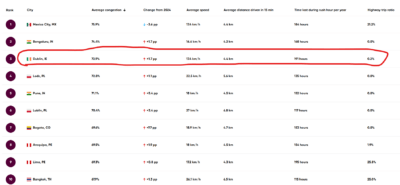
Oh, and our traffic congestion is absolute pants, you can thank Dublin City Council for that, their stewardship is about as dismal as you can hope for, 24 hour bus lanes in places that have no 24 hour bus service, motorcycles not allowed in bus lanes… Jobs that take forever to complete and come in way over budget, yep, that’s the ‘value for money’ that you can bank on never actually receiving from our municipality. Laughable stuff, apart from a historic town or two in Poland, the rest of the top ten is in Asia (which holds the majority of the worlds population) or South America. Well done Dublin… FFS.
MetLife launched its Group Life offering in Ireland from January 6, and they’ve gone broker-only from the off. Smart move. Group risk in Ireland is almost entirely an intermediated market, and MetLife clearly understands that. Their product bundles in 360Health — unlimited virtual GP access, wellbeing and support services — alongside the core death-in-service cover. It’s a credible proposition and they already have nearly 200 staff between Dublin and Galway, so they’re not parachuting in from abroad with no skin in the game.
More competition in group risk means more ammunition for you when you go back to existing clients at renewal. If you have SME clients with 10 or more employees and you haven’t spoken to them about group life recently, this is a good reason to pick up the phone. New entrant, potentially sharper pricing, value-adds that employees actually notice. That’s a decent story to tell.
Irish Life Health raised premiums by an average of 5.9% across its plans from 1 April. Level Health followed with increases of €48 on plans B, C and D from April 3. Medical inflation is the driver and it doesn’t show any sign of slowing down. If your clients haven’t heard about this yet, they’ll hear about it at their next renewal — and if you haven’t already flagged it, someone else will get the credit for having a conversation that was yours to have. Stay ahead of it.
Auto-enrolment went live on 1 January 2026. Three months in and the initial rush of communications is over. Now comes the part where the cracks appear: payroll systems not enrolling new starters automatically, contribution mismatches sitting unspotted in payroll reports, employees asking questions HR can’t answer. Q2 is when employers should be auditing their NAERSA submissions and checking everything is running as it should. Most won’t do this without prompting.
The real issue with Irish pensions is that we need a full review and redo on public pensions, the cost of them is insanity and they aren’t seen as ‘public debt’ but try to go a month without paying them and you’ll find out! The cost will eventually break the nation – but it isn’t impending so we should do what we always do in the face of dark clouds on the horizon, blissfully ignore them until the actual fire starts.
There’s also a clock ticking on opt-outs. Employees who enrolled on 1 January can leave the scheme and get a refund of their contributions from July 1 — six months in, as the rules allow. That’s a conversation you want to be having before it happens, not after someone opts out of a pension they should be keeping. If you have corporate clients in the auto-enrolment cohort, now is the time to check in. Don’t let the 6-month window catch you out.
The revised Consumer Protection Code (CPC 2025) came into force on 24 March 2026. The Central Bank had given firms a full year to prepare — it was published in March 2025 — but “plenty of time” has a way of becoming “almost out of time” very fast. The key change for intermediaries is in the Standards for Business Regulations: a cross-sectoral duty to act in the interests of customers and treat them fairly and professionally. That’s a broader standard than the old code and it isn’t softened by implementation guidance.
The CPC also consolidates the Code of Conduct on Mortgage Arrears (CCMA 2013), which is relevant for anyone dealing with mortgage clients in difficulty. Brokers Ireland has published a summary of key requirements for insurance brokers — if you haven’t read it, do it this week. A gap analysis now is a lot cheaper than a Central Bank inspection later.
| DAILY ECONOMIC INDICATOR HICP INFLATION — 3.6% (March 2026) The Harmonised Index of Consumer Prices (HICP) is the EU-standard measure of inflation — it’s what Brussels uses when comparing price levels across member states. The CSO published a flash estimate on 30 March showing Irish HICP at 3.6% in the twelve months to March 2026, up sharply from 2.5% the month before. The jump is almost entirely energy-driven: electricity, gas and transport fuels climbed 11.1% in a single month and are up 12.3% year-on-year. Food prices were essentially flat. The final CPI figures — which include the domestic picture — are due on 9 April. Why it matters to brokers: Energy costs of 12.3% are already in the data — that’s going to show up in household budgets by April and May, which means pressure on monthly outgoings for your clients. When money is tight, protection policies and pension contributions are the first things people look at cutting. Get ahead of that conversation now. On the mortgage side, sticky inflation at 3.6% gives the ECB less room to cut further, which keeps variable-rate mortgage costs elevated. Fixed rates remain the story to tell. The real pinch will come when we are being told ‘inflation is not that high’ (it actually will be because energy feeds into all of it and they conveniently strip energy out of core inflation), and economic growth can’t keep up. And just to ensure you are feeling the joy – the energy supply that comes from the gulf will be unaffected for the first 3 months it takes for tankers to get to Europe, so it’s the summertime when it will really kick in, and if we get a heatwave (more in Europe, we can’t even muster some good f”£king weather here) it will make it into a proper hot mess. |
▪ CSO CPI final on April 9. The HICP flash estimate was 3.6% for March — the full Consumer Price Index, which covers domestic prices in more detail, comes out Thursday. Worth watching if you’re advising clients on mortgage protection or income protection adequacy.
▪ AIFMD II transposition deadline: April 16. The updated CBI Alternative Investment Fund rulebook is expected to land before April 16. Not directly relevant to most retail intermediaries but if you have clients investing in alternative funds, flag it to whoever manages those relationships.
▪ Growth forecasts diverging sharply. The ESRI is forecasting a -5.7% economic contraction for 2026 while KPMG and the Central Bank are projecting around 3% growth. The gap is about how you count multinational IP activity. Modified Domestic Demand — the real-economy number — is pointing to around 2.5% growth. Don’t confuse headline GDP with what’s happening on your clients’ streets.
▪ PTSB cut mortgage rates twice since September. Permanent TSB has been one of the more aggressive movers in the market this cycle, with two reductions since September 2025. If you haven’t re-run the numbers for switcher clients recently, the market has moved enough to make it worth doing.
▪ ICS January hike was 0.25%-0.45%. For context: ICS raised owner-occupier fixed rates in January 2026 by between 0.25% and 0.45% depending on LTV band. The March hike was 0.35%-0.5%. Anyone who locked in with ICS before January is sitting pretty. Anyone looking to take out a new ICS fixed rate today is in a different world to six months ago.