
Leave your details and we'll call you back
We can call you at a time that suits you.


Before navigating the Irish property market, prospective applicants must have a clear understanding of the state of their personal finances. And with interest rates proving to be as volatile as ever, committing to a mortgage is highly risky without due diligence. That’s why conducting a thorough mortgage comparison in Ireland is one of the first steps to ensuring you secure the most favourable terms available.
For a while, local borrowing was dominated by legacy pillar banks, or at least, potential buyers were restricted to them; but now, having grown their share of new mortgage lending from just 3% in 2018 to 13% by 2021, non-bank lenders are changing the status quo and transforming the ecosystem, offering tech-driven alternatives that promise faster processing times at highly competitive rates.
At first glance, you’ll quickly realise that lenders are classified into two main categories: Traditional banks (AIB, Bank of Ireland, and PTSB) and non-bank lenders (Avant Money, MoCo, and Núa).
Brick-and-mortar banking institutions offer walk-in, in-person banking services, and a human-led underwriting process. Documentation is submitted per application and per institution. That is, with each traditional lender approached, a set of documents, aligning with specified requirements, is required, submitted and individually processed. The in-person, human-led process may appeal to potential borrowers who prefer to talk through unconventional income streams like self-employment and independent contracts face-to-face.
On the other hand, digital lenders offer fully digitised application collection and processing, with no reliance on physical branch networks. This eliminates overheads associated with maintaining physical locations and allows these lenders to offer more competitive lending rates. Their automated data tracking and paperless processes offer more efficiency than traditional banks, and because several assess variable and self-employed income more flexibly, they are worth including in any mortgage comparison in Ireland.
Interest rates are in constant fluctuation, making them a moving target for potential homebuyers conducting a mortgage comparison in Ireland. After recent rate adjustments, the ECB increased its deposit facility rate in June and September 2026, reaching 2.50%. According to data from the Central Bank of Ireland, the average rate on a new Irish mortgage was 3.53% in August, placing Ireland 11th highest in the euro area.
As current economic conditions continue to bring waves of uncertainty across different markets, more Irish borrowers are choosing the phased predictability of fixed-rate agreements. According to recent data, 92% of new mortgages were anchored on fixed rates. That’s the highest since early 2023.
This is due to how costly variable rates can be over time, when adjustments are made to respond to ongoing market shifts and lender pricing decisions.
Opting for the latter isn’t a quick fix when doing a mortgage comparison in Ireland, though. It’s essential to consider fixed-term rate lengths, associated breaking fees in case of early leavers, and the resultant rollover rate when fixed terms end.
The Central Bank’s mortgage measures apply equally to every lender in Ireland, digital or traditional. First-time buyers can borrow up to four times their gross income and second and subsequent buyers up to 3.5 times, with a minimum 10% deposit for both. Digital lenders cannot bypass these preset limits.
Where these categories of lenders differ, however, is how applicants’ incomes are calculated. While excluded with some lenders, others consider bonuses, overtime and other additional income more generously, and this can result in different, possibly higher maximum loan amounts.
Ultimately, all mortgage lenders operating in Ireland are subject to the same consumer protection rules, as set out by the Central Bank.
A low advertised interest rate does not guarantee the cheapest overall loan. When comparing Irish mortgages, evaluate these additional factors:
Comparing lenders isn’t just for first-time buyers trying to get a foot on the ladder. Existing homeowners in Ireland are switching mortgage lenders in growing numbers, and digital providers are competing hard for that business.
According to the Banking & Payments Federation Ireland (BPFI), homeowners switched nearly €1.7 billion worth of mortgages in 2025, up 57.3% from the year before. That momentum carried straight into 2026, with second-quarter switching values jumping another 24.8% year-on-year to hit €525 million.
The numbers show why. On a typical €300,000 mortgage over 30 years, the gap between the market’s lowest variable rate (3.85%) and the highest (4.85%) in August 2026 works out to about €177 a month. That is over €2,100 a year back in your pocket for the same loan amount.
You’re most likely to see meaningful savings if:
To make switching less of a headache, non-bank and digital lenders are actively tackling the main pain points:
With traditional retail banks starting to nudge their fixed rates upward, running a quick market comparison lets you lock in a better rate before the next round of adjustments takes effect.
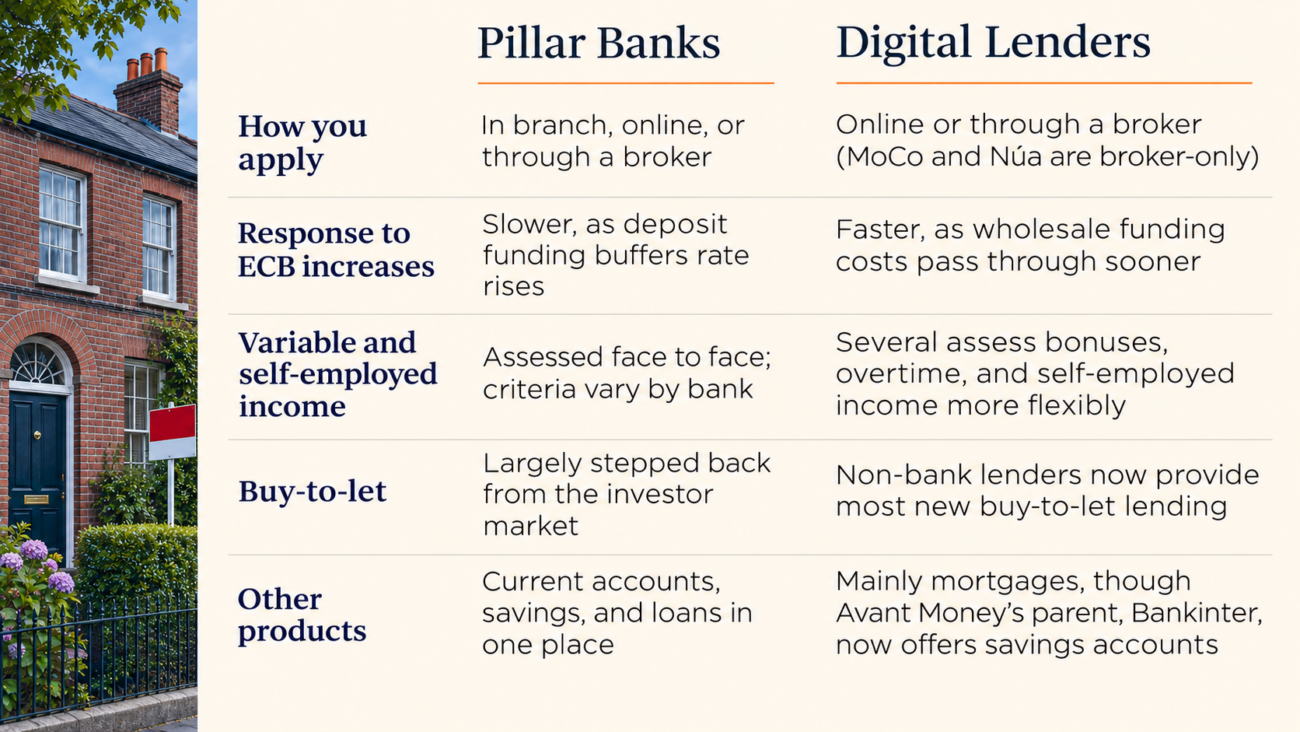
There is no single best choice for every borrower, but traditional banks and digital or non-bank lenders differ in ways that directly impact your application:
More borrowers in Ireland now use independent brokers to navigate the expanding market. BPFI data shows the broker share of Irish home loans has grown from just over 25% in 2019 to nearly 50% today.
The Irish mortgage market offers far more variety than it did a few years ago. Digital and non-bank lenders now compete directly with traditional retail banks on interest rates, approval speeds, and loan terms. As central bank adjustments filter through to fixed rates, shopping across the full market remains the single best way to protect your budget, whether you are buying your first home, trading up, buying an investment property, or switching lenders.