
Leave your details and we'll call you back
We can call you at a time that suits you.

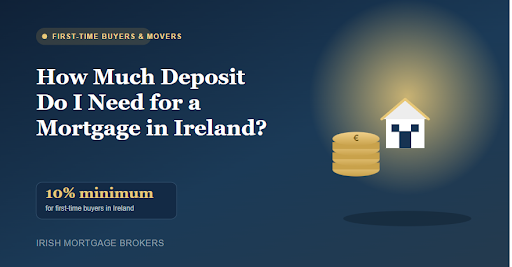
Saving for a mortgage deposit is one of the biggest milestones on the journey to homeownership. Whether you’re buying your first home, moving to a new property, or returning to the market, understanding how much you’ll need to save is essential.
In Ireland, the minimum deposit required depends on whether you’re a first-time buyer, a second or subsequent buyer, or purchasing an investment property. The amount you can borrow is also influenced by the Central Bank of Ireland’s mortgage lending rules.
At MortgageBrokers.ie, we help clients understand exactly how much deposit they’ll need and guide them through every stage of the mortgage process. In this guide, we’ll explain the current deposit requirements, how loan-to-value (LTV) works, and practical tips for reaching your savings goal.
A mortgage deposit is the portion of the property’s purchase price that you pay yourself. The remainder is funded through your mortgage, provided you meet the lender’s affordability and lending criteria.
For example, if you’re buying a home for €350,000 and you need a 10% deposit, you’ll contribute €35,000, while the lender provides the remaining €315,000, subject to approval.
Your deposit demonstrates to lenders that you’ve planned financially and can contribute towards the purchase of your home.
The minimum deposit for a mortgage in Ireland depends on the type of buyer you are.
Most first-time buyers need a 10% deposit.
For example:
This is why many people refer to a 10% deposit mortgage in Ireland when discussing first-time buyer mortgages.
If you’re buying your next home, you’ll generally also need a minimum deposit of 10% of the property’s value, subject to the Central Bank’s lending rules and lender assessment.
Investment properties usually require a significantly larger deposit, often 30%, meaning lenders will finance up to 70% of the property’s value.
One of the most important mortgage terms you’ll encounter is Loan-to-Value (LTV).
LTV is the percentage of the property’s value that you’re borrowing.
For example:
Your mortgage represents 90% of the property’s value, giving you an LTV of 90%.
A lower LTV means you’re borrowing less relative to the property’s value, which can improve your choice of mortgage products and, in some cases, the interest rates available.
While meeting the minimum deposit requirement is important, it’s wise to budget for additional costs associated with buying a home.
These may include:
Having savings beyond your deposit can make the buying process less stressful and help you manage unexpected expenses.
Lenders generally accept deposits that come from:
Your mortgage advisor can explain how different sources of funds are treated by individual lenders.
For many buyers, saving for a house deposit in Ireland takes time and careful planning.
Here are some practical strategies:
Calculate your expected purchase price and determine how much you’ll need for both your deposit and buying costs.
Setting up an automatic monthly transfer into a dedicated savings account demonstrates financial discipline and helps build your deposit steadily.
Review subscriptions, dining out, and discretionary expenses to identify opportunities to increase your monthly savings.
Large personal loans or increasing credit card balances can reduce your borrowing capacity and affect affordability.
Lenders like to see a regular savings pattern, as it provides evidence that you can comfortably manage future mortgage repayments.
Yes. Many first-time buyers receive financial assistance from parents or close family members.
Most lenders will request:
It’s important to discuss gifted deposits with your mortgage advisor early in the application process to ensure all documentation is in place.
If you haven’t yet reached your deposit target, there are several steps you can take:
Getting advice early can help you avoid disappointment and put you in the strongest position when you’re ready to apply.
Understanding deposit requirements is only one part of securing a mortgage.
At MortgageBrokers.ie, we help clients:
Whether you’re a first-time buyer or purchasing your next home, we’ll help you understand your options and make informed decisions.
For most first-time buyers and home movers, the minimum deposit is 10% of the property’s purchase price, subject to lender assessment and the Central Bank of Ireland’s lending rules.
Loan-to-Value (LTV) is the percentage of the property’s value that you’re borrowing. For example, borrowing €270,000 to purchase a €300,000 home gives you an LTV of 90%.
Yes. Many lenders accept gifted deposits from immediate family members, provided the appropriate documentation is supplied.
It’s highly recommended. In addition to your deposit, you’ll need to budget for legal fees, Stamp Duty, insurance, valuation costs, and moving expenses.
Yes. Consistent savings demonstrate good financial management and can strengthen your mortgage application by showing lenders you can comfortably manage regular repayments.
Saving for a mortgage deposit is one of the most important steps towards buying your home, but you don’t have to figure it out alone.
At MortgageBrokers.ie, we help buyers across Ireland understand their deposit requirements, calculate their borrowing capacity, and compare mortgage options from a range of lenders.
Whether you’re just starting to save or are ready to apply for mortgage approval, our experienced advisors are here to guide you every step of the way.
Contact MortgageBrokers.ie today for a no-obligation consultation and take the next step towards owning your home with confidence.