Leave your details and we'll call you back
We can call you at a time that suits you.

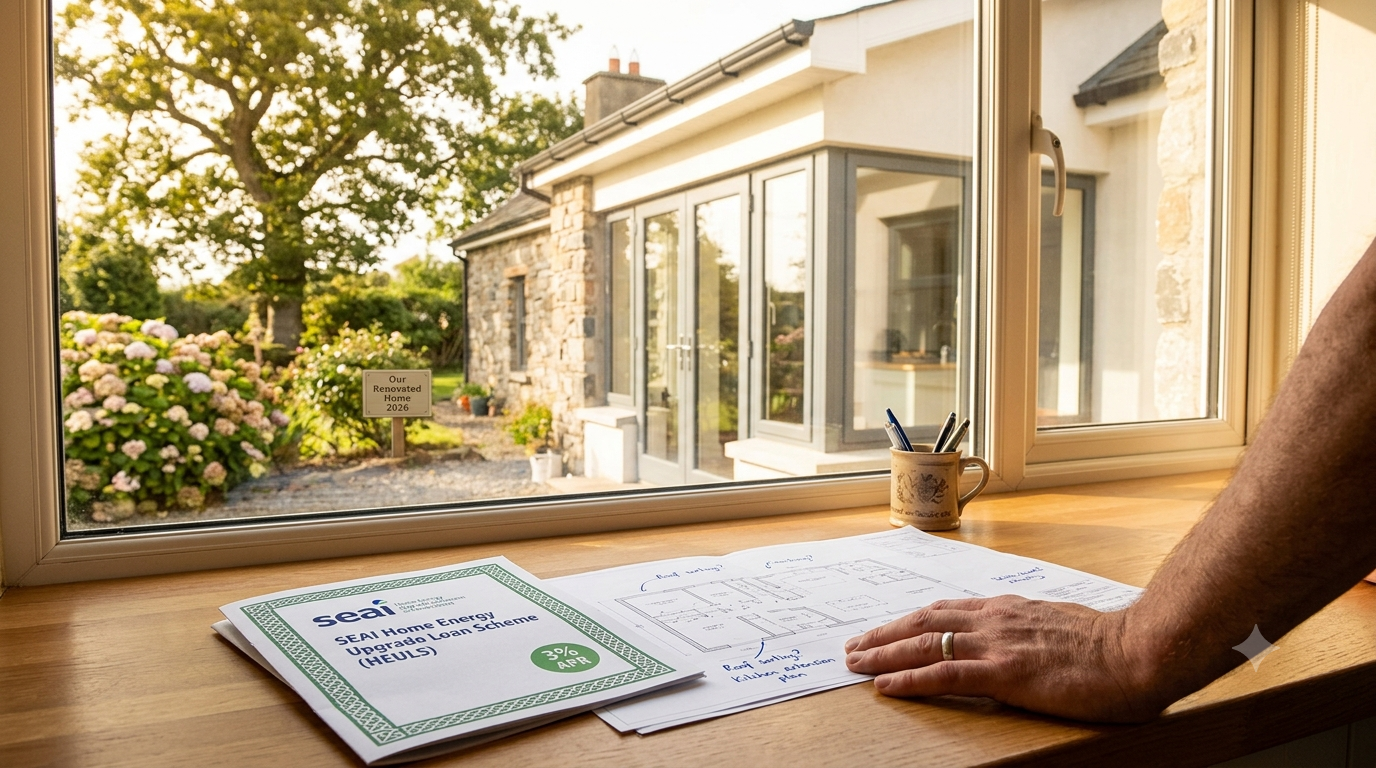
Whether you are planning a kitchen extension, a full house retrofit, or just trying to finally sort the roof before winter, one question comes up almost immediately: how do you pay for it? Home renovation costs in Ireland are significant, and unless you have a large lump sum sitting idle, you are going to need to think about financing. The good news is that there are more options available in 2026 than at any previous point, including some genuinely low-rate government-backed schemes that most homeowners do not even know exist.
Before you choose a financing route, you need a realistic handle on your project costs. Renovation costs in Ireland vary enormously depending on the scope, the contractor, and the region. Labour costs have risen sharply in recent years, and materials are still elevated compared to pre-pandemic levels.
One useful rule of thumb: small jobs in the €5,000 to €25,000 range typically suit a personal loan or credit union loan. Medium projects in the €25,000 to €80,000 range often go through a credit union or a lender like Avant Money. Large renovations of €100,000 or more almost always involve releasing equity through a mortgage top-up. Knowing which bracket your project falls into before you start shopping around saves a lot of time.
The most straightforward route for smaller renovations is an unsecured personal loan from one of the main Irish banks or non-bank lenders.
Avant Money is one of the most competitive options in this space. For loans over €30,000, they advertise Ireland’s best fixed rate at 6.7% APR as of early 2026. For amounts between €5,000 and €19,999, rates start from 8.5% APR. All Avant Money personal loans come with a fixed rate, so your repayment stays the same for the full term. On a €30,000 loan over five years at 6.7% APR, monthly repayments work out at approximately €587, with a total cost of credit of around €5,219.
The main limitation with personal bank loans is the amount most lenders cap unsecured personal loans below €75,000, and rates on larger amounts are less competitive than a mortgage top-up.
Credit unions are frequently overlooked by homeowners who go straight to their bank, and that is a mistake. Irish credit unions often offer extremely competitive rates on home improvement loans, and their approach to lending is more flexible than the algorithm-driven decisions you get at a bank.
The key advantages are no early repayment penalties, flexible loan terms, and a willingness to assess applications on a case-by-case basis, which is particularly useful if your income is non-standard, you are self-employed, or you have a complicated financial picture. Most credit unions also allow you to borrow without securing the loan against your home. You need to be a member to borrow, but joining is straightforward, and many credit unions now manage everything online. Credit unions are particularly strong for amounts from €5,000 to €80,000 and are worth checking before you assume a bank loan is your only option.
If your renovation involves any energy upgrade work, insulation, a heat pump, solar panels, new windows and doors, or a full deep retrofit. This is the most important section of this guide. The Home Energy Upgrade Loan Scheme (HEULS) offers rates that are dramatically lower than anything else on the market.
Backed by the government, the European Investment Bank, and the European Investment Fund, HEULS allows homeowners to borrow between €5,000 and €75,000 per property at 3% APR, compared to the 6–9% typically charged on a standard personal loan for the same work. Bank of Ireland and AIB joined the scheme in 2024, and Avant Money followed in early 2025.
Key features: unsecured loans with no charge taken over your property; borrowing from €5,000 to €75,000 per property on up to three properties; repayment terms from 1 to 10 years; and availability until 31 December 2026 or until funds are exhausted. The scheme must be linked to SEAI-eligible energy upgrade works, and up to 25% of the amount borrowed can be spent on non-energy-efficiency works alongside the main project.
This scheme is significantly underused by homeowners who qualify. If your renovation touches any energy upgrade element at all, it is worth investigating before you take out a standard personal loan at two to three times the rate.
Loans and grants work best together, and Ireland’s grant landscape in 2026 is the most generous it has ever been. The Government allocated a record €558 million to SEAI in Budget 2026, targeting 70,000 homes for energy upgrades this year. Heat pump grants nearly doubled in February 2026, and new grants for windows and doors launched in March.
Individual SEAI grants are available for insulation, heating system upgrades, heat pumps, and solar PV installations. The key advantage of combining grants with the HEULS loan is that the grant reduces the amount you need to borrow. For owners of vacant or derelict homes, the Vacant Property Refurbishment Grant provides up to €50,000, or €70,000 for derelict properties. First-time buyers who cannot secure commercial lending can combine this with the Local Authority Purchase and Renovation Loan.
For large renovation projects, typically anything above €80,000 to €100,000. A mortgage top-up is usually the most cost-effective financing route. A mortgage top-up means borrowing additional funds against your home by increasing your existing mortgage. Because the loan is secured against your property, the interest rate is typically much lower than a personal loan.
Bank of Ireland allows existing mortgage customers to borrow from €15,000 up to 90% of the value of their home through equity release, with terms from 5 to 35 years. AIB offers a similar product to existing customers. The trade-off is that your home is at risk if you do not keep up repayments. A mortgage top-up also involves valuation fees, legal fees, and a more involved application process. That said, for a €150,000 renovation, the difference in monthly repayments between mortgage-rate borrowing and a personal loan rate can be very substantial. A mortgage broker can help you assess whether a top-up with your existing lender is possible or whether it makes sense to switch lenders and take the additional borrowing as part of a new mortgage.
Do not confuse green loans with the HEULS scheme. Some banks advertise their own green home improvement loans at 4–6% APR, which is a separate product from the government-backed HEULS. They can still be useful but always check which product you are being offered.
Read the conditions on SEAI grants carefully. Grants require registered, approved contractors; must be completed within a set period; and require a BER assessment. Factor this into your project planning. And always consider the total cost of credit, not just the monthly repayment.
It is a particularly suitable time to finance a home renovation in Ireland, especially if your project has any energy-upgrade element. The combination of SEAI grants and the government-backed HEULS loan at 3% APR creates a financing environment that did not exist even a few years ago. For larger projects, a mortgage top-up remains the most cost-effective route if you have sufficient equity. Before committing to any product, get proper advice. A mortgage broker can help with top-ups, while a financial advisor can compare loan options across lenders.
Rates and scheme details correct as of May 2026. Always verify current rates and eligibility criteria directly with lenders, SEAI, and the SBCI before making decisions.