
Leave your details and we'll call you back
We can call you at a time that suits you.

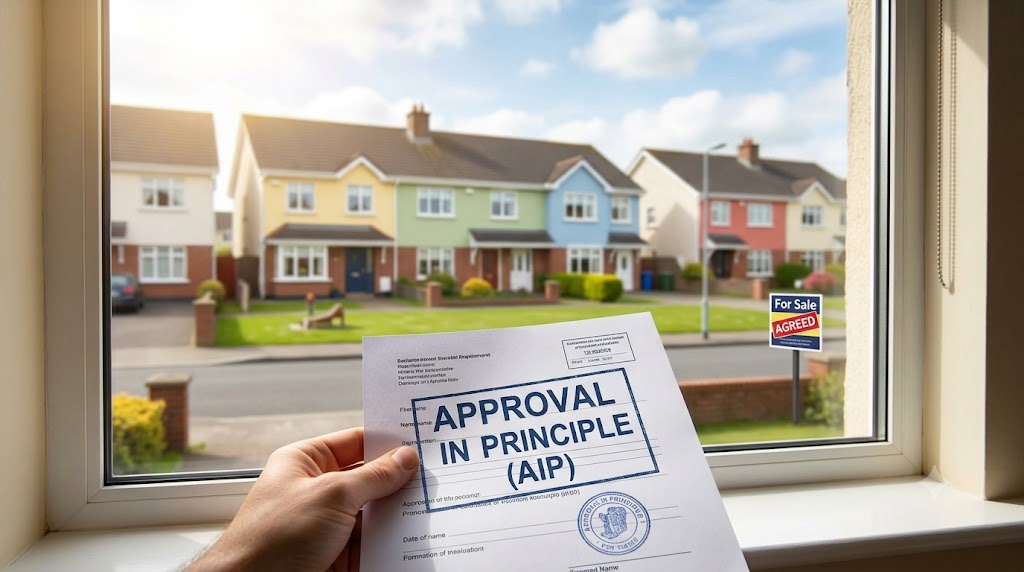
Buying a home in Ireland involves many steps, and one of the first major milestones is securing an Approval in Principle (AIP). If you have begun researching how to apply for a mortgage, you have seen the term everywhere, from estate agents to lenders to mortgage brokers. But what exactly is an AIP, how does it work and how long does mortgage approval take?
This guide breaks down everything you need to know about AIP Ireland, including borrowing limits, required documents, timelines, and how to strengthen your mortgage application.
An Approval in Principle is a lender’s initial assessment of how much they may be willing to lend you. It is based on your income, savings, deposit, and financial history.
It is not a full mortgage offer, but it is a strong indication that you meet the lender’s criteria.
An AIP gives you:
– A clear budget for house hunting
– Credibility with estate agents
– A competitive advantage in Ireland’s fast‑moving property market
Legally, no, but yes.
Most estate agents will not accept an offer unless you can show a valid mortgage approval in principle. In a market where properties receive multiple bids quickly, buyers without an AIP are rarely taken seriously.
Before applying for an AIP, it is important to understand the Central Bank’s lending rules. These determine how much mortgage you can get in Ireland.
Loan‑to‑Income (LTI) Limits
– First‑time buyers: Up to 4× gross income
– Second/subsequent buyers: Up to 3.5× gross income
Loan‑to‑Value (LTV) Limits
– Residential buyers: Up to 90% LTV (10% deposit)
– Buy‑to‑let: Up to 70% LTV (30% deposit)
Lenders can issue a limited number of exceptions each year, but these are not guaranteed and should not be relied upon.
Not all AIPs carry the same weight.
Soft AIP
– Quick online estimate
– No document review
– No credit check
– Not accepted by estate agents
Full AIP (Fully Underwritten)
– Full document review
– Credit check
– Verified by an underwriter
– Required before making offers
When you are ready to bid on a property, you need a full AIP.
Preparing your documents early is the best way to speed up your mortgage application.
For PAYE Employees
– Passport or driving licence
– Proof of address
– 3 recent payslips
– Employment Detail Summary (EDS)
– Salary Certificate
– 6 months of bank statements
– Evidence of deposit or gift letter
For Self‑Employed Applicants
– 2 years of accounts
– 6 months of personal + business bank statements
– Accountant confirmation of tax compliance
The timeline depends on your preparation and the lender.
Typical AIP Timelines
– Straightforward cases: 5–7 working days
– Broker fast-track cases: Sometimes 24–48 hours
– Complex cases: 2–3 weeks
Full Mortgage Timeline
From AIP to drawdown, the full process usually takes 8–16 weeks, depending on the following:
– Lender processing times
– How quickly you go sale agreed
– How fast you satisfy AIP conditions
Most AIPs are valid for 6 months. Some lenders issue twelve‑month approvals, but updated documents are usually required after six months.
If your AIP expires before you find a property, renewing it is usually straightforward if your financial situation has not changed.
An AIP is only the beginning. Here is the full mortgage journey:
1. AIP issued
2. House hunting within your approved budget
3. Sale agreed and booking deposit paid
4. AIP conditions satisfied
5. Property valuation
6. Formal loan offer issued
7. Contracts signed
8. Mortgage drawdown
Common AIP conditions include updated bank statements, employment confirmation, and mortgage protection insurance.
1. Clean Up Your Bank Statements
Avoid overdrafts, reduce gambling transactions, and show consistent savings.
2. Avoid New Loans
New credit reduces borrowing capacity and raises questions for underwriters.
3. Check Your Credit Report
You can access your Central Credit Register report for free.
4. Prepare Documents Early
Missing documents are the number one cause of delays.
5. Consider Using a Broker
Brokers can compare lenders, advise on suitability, and manage timelines — usually at no cost to you.
An AIP:
– Defines your budget
– Shows estate agents you are a serious buyer
– Speeds up the mortgage process
– Gives you a competitive edge in a fast‑moving market
Bottom Line
An Approval in Principle is the foundation of the Irish mortgage process. In particular, for first-time buyers it gives you clarity, credibility, and confidence as you begin your property search. By preparing your documents, understanding Central Bank rules, and knowing how long mortgage approval takes, you can position yourself for a smooth and efficient mortgage journey.