Leave your details and we'll call you back
We can call you at a time that suits you.


In theory, everyone and their associate knows just how important it is to learn, build and maintain healthy financial habits, but the daily realities of ordinary Irish people don’t necessarily leave room for intentional financial planning in Ireland, especially when dealing with the ever-changing local interest rates, fluctuating global markets, and shifting buying power due to increases in the costs of basic goods and services.
Now, add housing expenses, existing debt commitments, local taxes, insurance, and education, and it becomes clear that oiling the personal finance machine is tough. But the good news? It’s not impossible.
While the layers of everyday finances make planning seem like rocket science, the reality is very different. Think of it as studying the relationship between your income, expenses, and savings. Do they work with or against each other? That’s the start.
Systematic thinking! The most common mistake people make is looking at the different elements of their finances in isolation. For example, It’s impractical to measure your financial muscle based only on your income bracket.
Let’s look at a scenario:
John has a net income of €3,000 per month. He lives on a family property and pays €1,000 towards debt and expenses. He saves $1,200 monthly and has a surplus of €800.
Jane earns $5,500 net income monthly. She has long-term debt, a credit card, and rental commitments, and she collectively contributes €4,800 monthly to them. She has no savings and retains a €700 surplus.
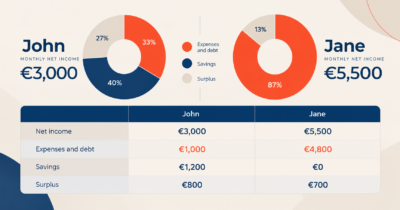
At first glance, Jane has bigger financial biceps, but in reality, John has greater agility. Your total income only tells you what you earn, but your expenses and savings threshold tell you how you fare.
Effective financial planning is analysing how your current income enables you to cover current debt commitments, replenish your buffer/savings account, and manage unexpected expenses without compromising your quality of life.
This way, you get a bigger-picture view of your financial position and understand where a significant portion of your income goes. After all, you can’t treat an ailment without a clear diagnosis.
These aren’t quick fixes, but part of a long-term approach to financial planning in Ireland, and require consistency, patience and enough discipline to make adjustments as your circumstances change.
According to the Irish Department of Finance’s 2024 Financial Literacy Mapping Report, 43% of adults in Ireland lack the financial knowledge and skills needed to meet the Organisation for Economic Cooperation and Development’s (OECD) basic financial literacy standard.
And as a result:
These figures are concerning because financial setbacks don’t exist in an isolated vacuum. They can bleed into other areas of your life, especially when a large portion of your income is reserved for debt and daily expenses. The result is usually missed or delayed payments and an overreliance on debt, leaving little to no room for savings.
It’s a frustrating cycle, to say the least.
Proper financial planning in Ireland doesn’t mean you’re immune to life’s setbacks, nor does it miraculously solve current financial issues. It simply gives you a holistic view of what could potentially be adjusted.
Because, like John and Jane, everyone’s finances are different and require equally unique plans to address shortfalls, overcommitments, and changing circumstances. Your financial plan must reflect your income, existing debt responsibilities, a true reflection of your daily expenses, and your long-term priorities. Then, from this baseline, you can confidently make the necessary adjustments to get you to what you consider comfortable.
Here’s what you can do to build a plan that addresses your current financial circumstances:
Again, treatment without proper diagnosis cannot work, so you need to do a full and honest audit of your current finances:
Check your bank statements, interest rates on current debt, spending habits, average costs of non-negotiable expenses, and your overall income-to-expense ratio.
With your finances in full view, you can now look at lower-hanging fruit like money spent on entertainment, dining out, subscriptions, insurance premiums, cellphone contracts and other services you can do without:
If you have long-term debt repayment commitments for loans, credit cards or overdrafts, don’t just look at the minimum monthly repayments. Instead, look at the portions that go towards interest, and how the principal reduces over time.
This is especially important with credit cards, where you can continue borrowing as you repay. You’re most likely spending more than you repay, resulting in an increasing balance and interest costs.
Now that you’ve reviewed your income, expenses, and long-term debt, you’re better positioned to decide how much of your disposable income is diverted to your savings pot. At this stage, it’s easy to fall into the trap of excessively committing to savings without considering a buffer for miscellaneous expenses.
The aim here is to strike a balance, not favour one goal over the other.
The tough pill to swallow is that your financial position isn’t static, and neither should your financial planning in Ireland. As you repay debt and service expenses, the relationship between your income and commitments shifts, and naturally requires adjustments.
For example, if your surplus grows as debt reduces, there’s an opportunity to increase your savings contributions, make lump-sum payments towards remaining balances, or invest.
While it’s possible to effectively manage your own financial profile, if buying a house forms part of your long-term financial plans, then soliciting the assistance of a financial planner or mortgage broker can help you assess how financially prepared you are to commit without adding excessive weight to your scale.
You’ll have a clear picture of:
Financial planning in Ireland is especially important when buying a home is one of your long-term goals. If you’re considering mortgage options, get in touch with our expert mortgage brokers to assess your options and find competitive offers across lenders.