
Leave your details and we'll call you back
We can call you at a time that suits you.

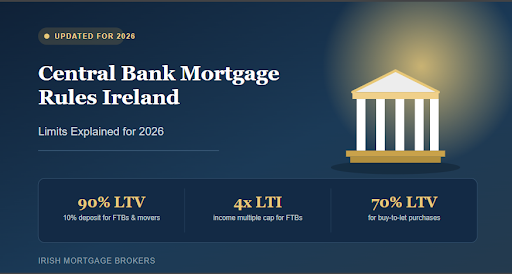
If you’re planning to buy a home in Ireland, understanding the Central Bank mortgage rules is one of the most important steps before applying for a mortgage.
These rules determine how much you can borrow, the minimum deposit you’ll need, and the circumstances where lenders can approve loans above the standard limits.
At MortgageBrokers.ie, one of the most common questions we receive is:
“How much can I borrow under the Central Bank mortgage rules?”
In this guide, we’ll explain the 2026 Central Bank mortgage rules in Ireland, including Loan-to-Income (LTI) limits, Loan-to-Value (LTV) requirements, mortgage exceptions, and what the rules mean for first-time buyers, home movers, and buy-to-let investors.
The Central Bank of Ireland introduced mortgage lending rules to encourage responsible lending and reduce the risk of borrowers taking on unsustainable levels of debt.
These rules apply to most residential mortgages in Ireland and are based on two key measures:
Although every lender follows these rules, each bank has its own underwriting criteria when assessing affordability and mortgage applications.
One of the best-known rules is the Central Bank 4x income rule.
Most first-time buyers can borrow up to:
4 times their gross annual household income.
For example:
Home movers can generally borrow up to:
3.5 times their gross annual household income.
For example:
These limits are the starting point. Lenders will also assess affordability, employment, existing financial commitments, and your overall financial circumstances before approving a mortgage.
Loan-to-Income (LTI) measures the relationship between your income and the size of your mortgage.
The formula is simple:
Mortgage Amount ÷ Gross Annual Income = LTI
For example:
Even if you qualify under the LTI limit, you’ll still need to satisfy the lender’s affordability assessment, including stress-testing your ability to meet repayments if interest rates increase.
Loan-to-Value (LTV) measures how much you’re borrowing compared with the property’s value.
For most principal private residences:
For buy-to-let properties:
Example:
The lower your LTV, the more equity you have in the property, which may give you access to a wider choice of mortgage products.
The mortgage lending rules apply to most residential mortgages, but there are limited exceptions.
Some specialised lending products may be treated differently, and in 2026 the Central Bank introduced a targeted amendment exempting certain principal home bridging loans from the standard LTI limit.
Many buyers are surprised to learn that lenders can approve some mortgages outside the standard lending limits.
These are known as mortgage exceptions.
Each lender is permitted to allocate a limited proportion of new lending above the standard LTI and LTV limits.
For example, a lender may approve a mortgage above the normal income multiple where the application is particularly strong.
However, exceptions are not guaranteed and are considered on a case-by-case basis.
Factors that may strengthen an application include:
Because lenders have a limited allocation of exceptions each year, availability can vary throughout the year.
No.
Receiving a mortgage exception simply means the lender is willing to lend above the standard regulatory limit.
You’ll still need to satisfy all other lending requirements, including:
A mortgage exception should be viewed as an opportunity rather than an entitlement.
The mortgage measures were introduced following the financial crisis to help create a more stable housing market.
Their objectives include:
While the rules can limit borrowing capacity, they are designed to reduce financial risk for both borrowers and lenders.
Although you can’t change the Central Bank rules, you can improve your mortgage application by:
Lower monthly loan repayments improve affordability.
A larger deposit reduces your Loan-to-Value ratio and may improve your mortgage options.
Paying all loans and credit commitments on time strengthens your application.
Regular savings demonstrate that you can comfortably manage mortgage repayments.
A broker can assess your eligibility, estimate your borrowing capacity, and identify lenders whose criteria best match your circumstances.
Understanding the Central Bank mortgage rules is only the first step.
At MortgageBrokers.ie, we help clients:
Whether you’re a first-time buyer, home mover, or switching your mortgage, we’ll help you understand your options and present the strongest possible application.
Most first-time buyers can borrow up to four times their gross annual income, while most second and subsequent buyers are generally limited to 3.5 times their gross annual income, subject to lender assessment.
Loan-to-Value is the percentage of the property’s value that you borrow. Most owner-occupier mortgages are limited to an LTV of 90%, requiring a minimum 10% deposit.
Possibly. Lenders have a limited number of mortgage exceptions available each year for applicants who meet specific criteria. Approval is at the lender’s discretion.
Yes. All regulated lenders must comply with the Central Bank’s mortgage measures, but each lender has its own underwriting policies and affordability assessments.
The core LTI and LTV limits remain in place. A targeted amendment introduced in 2026 exempts certain principal home bridging loans from the standard LTI limit, while the broader mortgage framework remains unchanged.
Understanding the Central Bank’s mortgage rules can make the difference between a smooth mortgage journey and unnecessary delays.
At MortgageBrokers.ie, we help buyers across Ireland understand how much they can borrow, whether they may qualify for a mortgage exception, and which lenders are best suited to their circumstances.
Whether you’re buying your first home, moving house, or refinancing an existing mortgage, our experienced advisors are here to guide you every step of the way.
Contact MortgageBrokers.ie today for a no-obligation consultation and let us help you secure the right mortgage with confidence.